
Network wiring is one of those projects that looks simple from the outside and turns into a nightmare when it is planned poorly. A bad cabling job in a Minneapolis office produces years of intermittent issues, mystery downtime, and unhappy users who never quite know whether to blame the network, the laptop, or the building.
A good plan prevents almost all of that. This guide walks through how to plan a network cabling project for a Minneapolis office: standards to specify, common pitfalls in older Twin Cities buildings, and a clean checklist that turns a chaotic install into a predictable one.
If you are starting from scratch, our guide on How To Plan A Network Wiring Project For your Minneapolis office breaks the process into clear phases from site survey to final testing.
Key Takeaways
- Specify Cat6A as the floor for new installations; Cat6 is acceptable only for short runs in budget-constrained tenant spaces.
- Plan for 1.5 to 2 drops per workstation and at least one ceiling drop per 1000 square feet to support wireless access points.
- Older Minneapolis buildings often hide asbestos and obsolete cabling above the ceiling tiles; budget time for survey before pulling new cable.
- A clean cable management plan in the IDF or MDF is the single biggest predictor of how easy the network is to troubleshoot for the next decade.
Why Network Wiring Planning Matters in Minneapolis
Minneapolis office stock is mixed. Some tenants are in modern fiber-served towers in the North Loop or downtown core; others are in 1970s and 1980s buildings in the warehouse district, Northeast, or southwest suburbs that have layers of legacy cabling above the ceiling.
What works in one building rarely works in the next. A solid plan starts with a written assessment of the actual space, not a generic per-drop quote from a contractor who has not walked the site.
A well-executed Minneapolis network cabling installation starts with the same site-specific planning principles outlined here, and understanding the full process helps owners set realistic expectations before contractors arrive on site.

Minneapolis Network Cabling Project Planning Cheat Sheet
- ✓Default cable spec for new installs – Cat6A
- ✓Drops per workstation – 1.5 to 2
- ✓Wireless access points – 1 per 1000 sq ft
- ✓Typical 7,500 sq ft cabling cost – 12,000 to 22,000 USD
- ✓Typical 7,500 sq ft cabling timeline – 2 to 3 weeks
- ✓Required for older buildings – Asbestos and abandoned-cable survey
Figures from Switchback Systems engagements with Twin Cities tenant build-outs, 2023-2025.
Cabling Standards to Specify in 2026
Cat6A is the right specification for any new install in a Minneapolis office in 2026. It supports 10-gigabit Ethernet at distances up to 100 meters, future-proofs the install for at least the next decade, and costs only marginally more than Cat6 once labor is included.
Fiber should be considered for any backbone run over 90 meters, between floors, or between buildings. Single-mode fiber is the right choice for new installs even when the current network does not need it; the extra cost is small and the future flexibility is large.
How Many Drops You Actually Need
A common mistake is to under-spec wall drops. Plan for 1.5 to 2 cable drops per workstation, even in mostly wireless environments
. The extra capacity covers VoIP phones, secondary monitors with docking stations, and the inevitable user who plugs in a printer or scanner directly .
Ceiling drops for wireless access points need their own plan. The rule of thumb is one access point per 1000 square feet of office space, with adjustments for high-density conference rooms and dense cubicle areas.
Each access point gets its own dedicated cable run.

Common Pitfalls in Older Twin Cities Buildings
Twin Cities buildings constructed before 1990 often hide asbestos in floor tile, pipe insulation, and sometimes ceiling material. Pulling cable above suspended ceilings or through walls without a survey first is how a small cabling project turns into an environmental issue.
Older buildings also tend to have layers of obsolete cabling above the ceiling: telephone, coax, abandoned data, and occasional unused fiber. Best practice is to remove abandoned cable while pulling new, both to comply with current code and to keep the environment clean for the next change.
Planning the IDF and MDF Properly
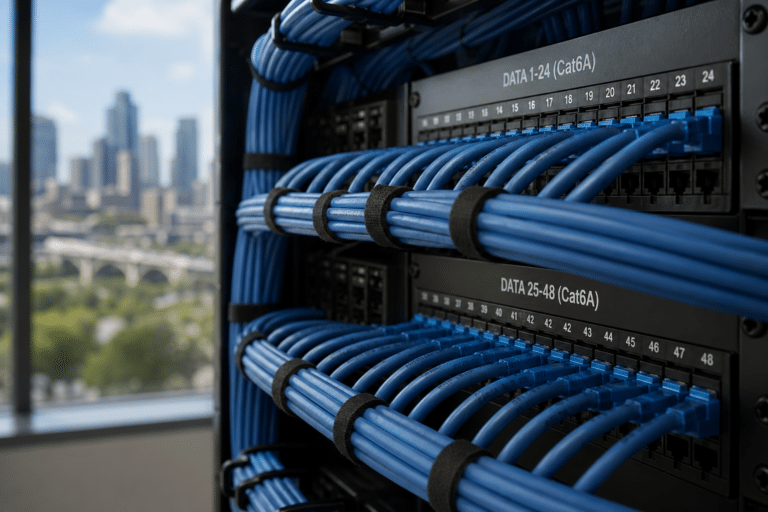
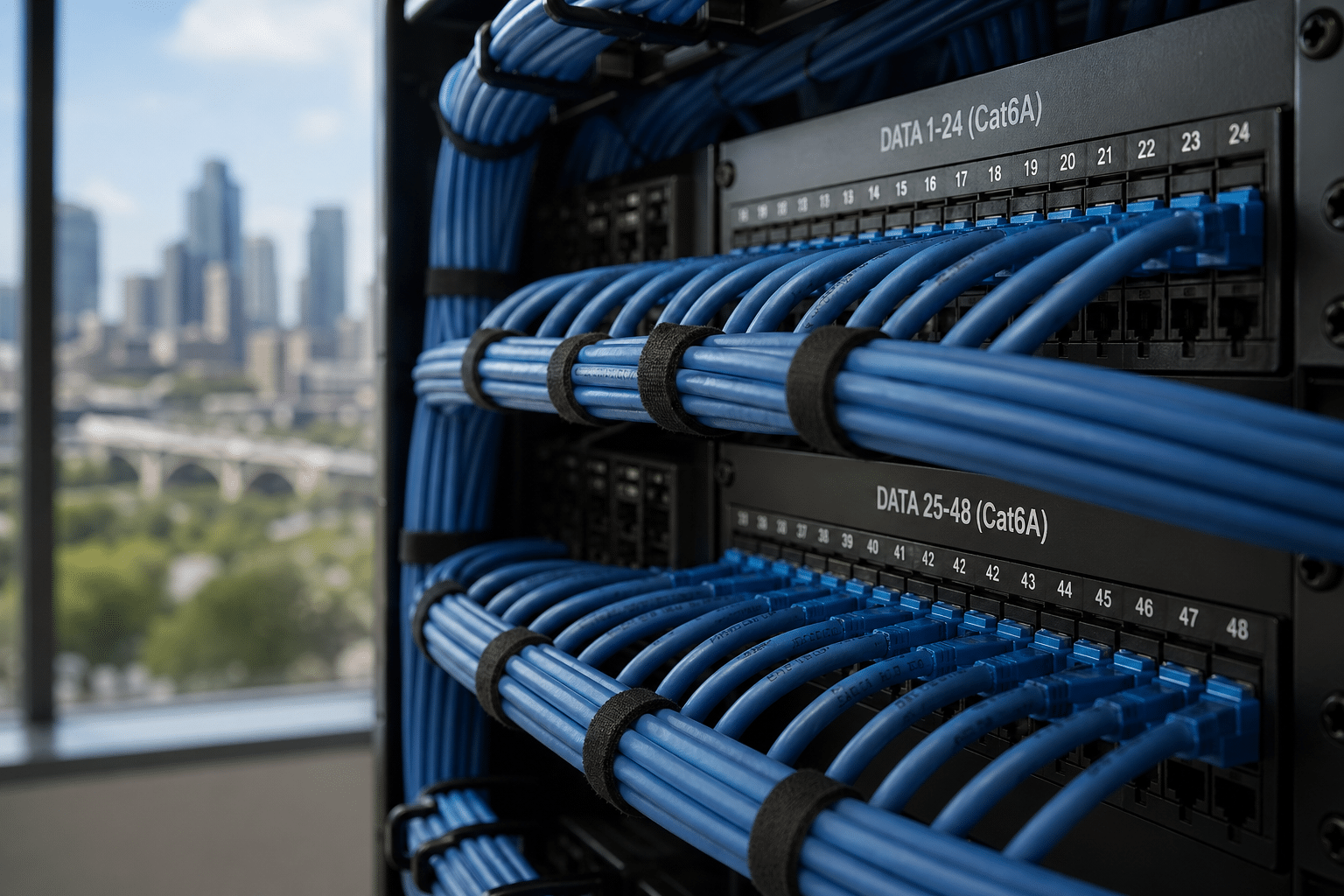
The intermediate distribution frame and main distribution frame are the rooms or closets where your network actually lives. A clean install includes a labeled patch panel, vertical and horizontal cable management, sufficient power and UPS capacity, and ventilation that handles the heat output of the active equipment.
Spending an extra hour per closet on labeling and cable management saves a decade of troubleshooting time. Every cable should be tagged on both ends, every patch panel port should match the wall jack number, and every cross-connect should be documented.
Cheap installs skip this step. Real ones never do.
Project Timeline and Budget for a Minneapolis Office
A typical Minneapolis tenant build-out for a 5,000 to 12,000 square foot office runs 2 to 4 weeks for cabling work, depending on building access, after-hours requirements, and the condition of the space. Budget falls between 8,000 and 35,000 dollars for the cabling portion alone, exclusive of active equipment.
Larger projects, such as a 25,000 square foot multi-tenant build-out or a campus-style installation, run 4 to 10 weeks and budget into the six-figure range for cabling. Time-of-day restrictions and union requirements in some downtown buildings extend the timeline; plan for them up front rather than as a surprise.
Why Minneapolis Businesses Trust This Approach
Owners across Minneapolis keep coming back to the same playbook for network cabling and wiring minneapolis. They want fast answers from someone who already knows their environment.
That is the difference between a vendor and a partner. A partner has read your runbook, walked your floor, and met the team that opens tickets at 7 a.m.
For a deeper look at how this plays out on the ground, see our coverage of network cabling and wiring in Minneapolis. The page documents what we cover, what we do not, and how response windows are measured.
Pricing transparency tends to be the second sticking point. Owners want a number on a page, not a quote that takes a week to assemble.
We publish typical engagement ranges and explain what moves them. The conversation is shorter and the proposal is closer to what you actually sign.
Service area coverage is the third concern. Minneapolis is not a single block, and the path between buildings matters when minutes count.
You can also read our Minneapolis network cabling installation overview for a related look at the local market. It is a useful companion piece if you are weighing options across nearby neighborhoods.
The short version is this. Local presence, parts on the truck, and clear pricing are the three habits that separate the providers worth keeping from the ones worth replacing.
Onboarding tends to be the moment owners decide whether the relationship will work. A documented intake, a real cutover schedule, and a single point of contact during the first thirty days set the tone.
After that, the rhythm is simple. Monthly reviews keep small problems from compounding, and quarterly business reviews translate technical decisions into plain language for the team.
Most Minneapolis owners do not want a lecture about technology. They want a partner who answers the phone, sticks to the budget that was agreed on, and tells them when something in the environment is changing.
That is the operating standard we publish, and it is the one we are willing to be measured against in writing.
Frequently Asked Questions
How long does network cabling take to install in a Minneapolis office?
Most 5,000 to 12,000 square foot offices take 2 to 4 weeks of cabling work. Smaller suites can be done in under a week.
Larger build-outs run 4 to 10 weeks depending on building access and after-hours requirements.
Should I use Cat6 or Cat6A in 2026?
Cat6A is the right floor for any new install. The cost difference once labor is included is small, and Cat6A future-proofs the cabling for 10-gigabit and beyond.
Cat6 is acceptable only for short runs in tight tenant budgets.
What does a cabling project cost for a 7,500 square foot Minneapolis office?
Most installs in that range fall between 12,000 and 22,000 dollars for cabling labor and materials, exclusive of switches and access points. Older buildings with asbestos or abandoned cable issues run higher.
Do I need to remove abandoned cabling above the ceiling?
Most current building codes require removal of abandoned cable when pulling new. It is good practice regardless.
Twin Cities inspectors increasingly flag this on commercial build-out permits.

About the author
Steve Dempsey - Owner
Steve Dempsey is the owner of Switchback Systems, a Minneapolis PBX and VOIP phone-system specialist that has supported local businesses for over 20 years across brands like Vertical, Avaya, and Nortel.
