
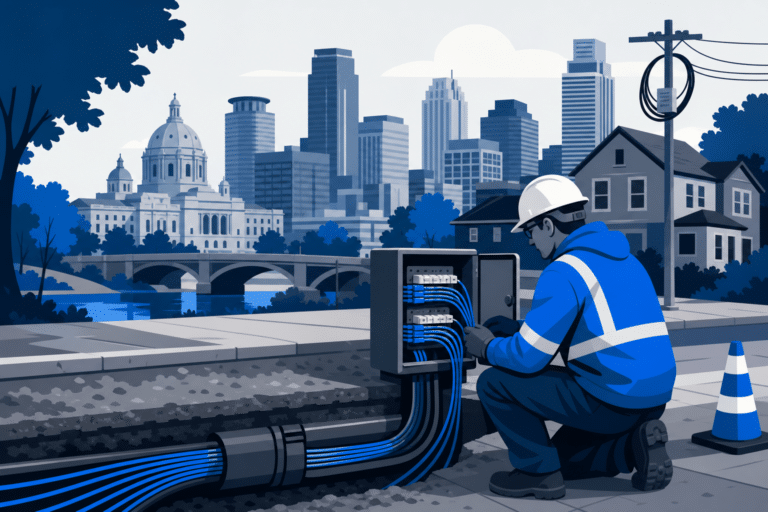
Fiber optic cabling has become the backbone of modern offices across the Twin Cities, replacing aging copper that struggles with cloud apps, VoIP, IP surveillance, and gigabit workloads. Knowing what a real install costs in this market is the first step to budgeting one without surprises.
This guide breaks down the price ranges, the cost drivers, and the project flow you should expect from a commercial fiber project in the Twin Cities metro. We share concrete numbers for small and medium builds, per-drop pricing, and the labor share that quietly controls most fiber budgets.
Key takeaways from this article:
- Small Twin Cities office fiber jobs with 2 to 4 drops under 300 feet typically run $3,000 to $8,000 installed, while mid-size 5 to 12 drop builds land in the $8,000 to $25,000 range.
- Per-drop pricing for commercial fiber usually falls between $250 and $1,000, with routing complexity and termination requirements doing most of the moving.
- Labor accounts for 60 to 80 percent of a fiber project, so site complexity matters more than cable choice when you set the budget.
- Finished retrofit spaces with limited conduit access run 15 to 30 percent higher on labor than open-ceiling or new-construction work.
Why Twin Cities Businesses Are Upgrading to Fiber Optic Cabling
Offices across Minneapolis and Saint Paul are running into the limits of older Cat5e and early Cat6 runs. Cloud platforms, 4K video conferencing, IP surveillance, and Wi-Fi 6E access points all push more traffic than legacy copper was designed to carry.
Fiber solves the bandwidth problem and adds a longevity advantage that copper cannot match. A properly installed single-mode or OM4 backbone is generally specified for a 20 to 30 year service life, which makes it a sensible asset to amortize over a long commercial lease.
Tenants in older Class B and Class C buildings often inherit risers that were never designed for current device density. Pulling new fiber gives you a clean path and removes the layered patchwork of legacy copper that drives ongoing maintenance calls.
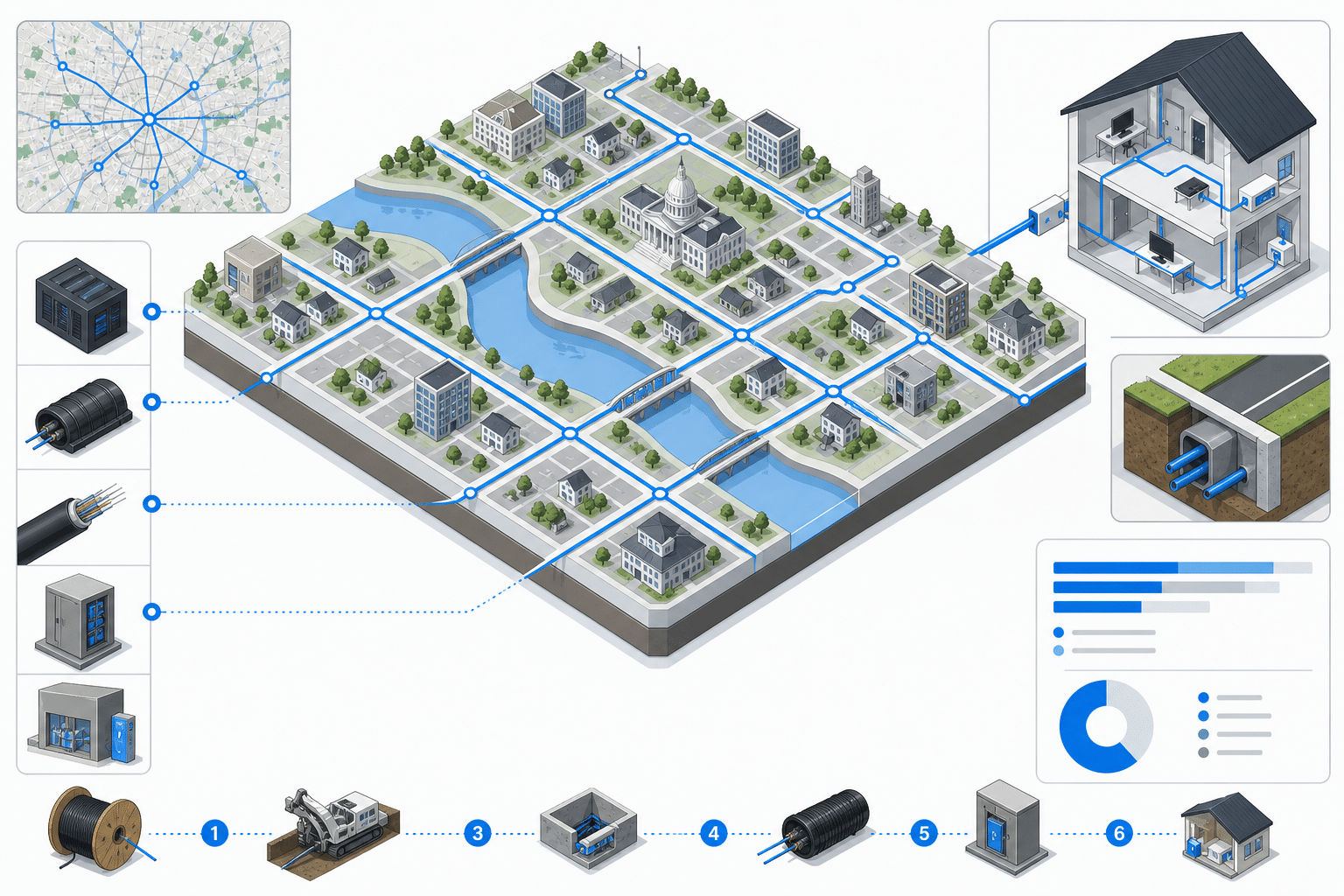
Fiber Optic Cabling Installation Costs: St. Paul and Minneapolis Market
Ranges reflect typical commercial fiber projects in the Minneapolis and Saint Paul metro; final pricing depends on site survey, building conditions, and certification requirements.
What Drives Fiber Optic Installation Costs in the Twin Cities
Three variables move the price more than anything else: total cable footage, number of terminated drops, and the difficulty of the pathway between them. Every other factor is essentially a modifier on those three.
Pathway difficulty is the silent budget killer in this market. Older brick-and-timber buildings in Lowertown, the North Loop, and downtown Saint Paul rarely have generous conduit, so technicians often end up coring walls, fishing chases, and routing around HVAC and existing low-voltage runs.
Cable type matters too, but less than most owners think it does. Single-mode and multimode fiber are close enough in raw cable cost that the optics and termination choices, not the strands themselves, usually drive material spend.
Finally, schedule and access add cost in ways that never appear on a spec sheet. After-hours work in occupied office space, weekend pulls in a medical clinic, and coordination with a building engineer in a multi-tenant high-rise all stretch the labor line.
Typical Pricing for Small and Medium Fiber Projects
A small Twin Cities office with 2 to 4 fiber drops and runs under 300 feet typically installs in the $3,000 to $8,000 range, including materials, terminations, and certification testing. That bracket covers most single-suite professional offices, dental practices, accounting firms, and small clinics.
A mid-size Minneapolis business that needs 5 to 12 drops across 300 to 1,000 feet of cable usually budgets $8,000 to $25,000 installed. Pathway complexity and building conditions decide where you actually land in that band, with multi-floor work and crowded ceilings pushing toward the top.
Per-drop pricing is another common way contractors quote the same work. Commercial fiber drops generally run $250 to $1,000 each depending on routing complexity, connector type, and whether fusion splicing is required at the termination.

Per-Foot Pricing and the Hidden Cost of Complex Routing
Installation and termination labor for fiber typically prices at $1 to $6 per linear foot for straightforward indoor runs. Once routing has to navigate fire-rated walls, finished ceilings, or conduit that is already crowded, the range climbs to $7 to $12 per foot.
Riser work in a Saint Paul high-rise is a textbook example of the upper band. Penetration through fire-rated floors requires firestopping per code, sleeves where appropriate, and coordination with the building engineer, and all of that gets billed against the linear footage.
Open-ceiling spaces, brand new tenant improvements, and clean cable trays let crews work faster, so per-foot rates stay near the bottom of the range. A simple comparison between a new-build suite and an identical retrofit can show a 30 to 40 percent difference in fiber cost per square foot.
How Labor and Materials Split the Total Budget
Across commercial fiber projects, labor and installation account for 60 to 80 percent of total expenses. That ratio holds whether you are doing a 4-drop conference room build or a 60-drop floor refit.
Fiber cable, connectors, enclosures, racks, and patch panels make up the remaining 20 to 40 percent of the budget. Bulk cable can run under a dollar per foot at wholesale and up to $6 per foot for high-count backbone, with connectors and enclosures adding incremental cost on top.
Skilled fiber technician rates in the Twin Cities track the broader national range of $65 to $150 per hour. Fusion splicing specialists trend toward the top of that band because certified splicers are not interchangeable with low-voltage generalists.
Single Mode vs Multimode: Choosing the Right Fiber for a Twin Cities Project
For most office runs under 150 meters, OM4 multimode fiber delivers the lowest total link cost because transceivers are cheaper and field termination is simpler. That covers the vast majority of horizontal runs in Twin Cities office space.
Single-mode fiber, usually OS2, is the right call for inter-building links, campus backbones, and high-rise risers. It costs slightly more in cable and optics, but its distance and bandwidth headroom protect against expensive re-pulls when the network upgrades to 400G or beyond.
Many local installers now recommend a hybrid design: single-mode on the backbone and risers, OM4 multimode for horizontal cabling to workstations and access points. That layout balances current cost against a 20 year future-proofing window.
Retrofits Versus New Construction in the Twin Cities Market
Retrofitting fiber into a finished Twin Cities space almost always costs more than running it during construction. Labor on retrofit jobs with limited conduit access runs 15 to 30 percent higher than open-ceiling or new-build work.
The reason is access. Pulling cable above a finished drop ceiling, fishing through demising walls, and protecting the existing tenant environment all slow crews down and add coordination overhead to every shift.
If your build-out is still in the planning stage, scheduling the fiber pull during framing and rough-in can cut total fiber cost by roughly a third. That single decision often pays for any upgrade from multimode to single-mode on the backbone, with budget left over for spare strands.
What to Expect During a Twin Cities Fiber Installation
A typical commercial fiber project starts with a site walk and a cabling design document. Expect the technician to ask about device counts, future expansion, closet locations, and any building rules around after-hours work.
Pulls usually run in shifts that respect tenant operations, with testing and certification happening as each section is dressed in. Every fiber pair should be tested with an OTDR or insertion loss meter and documented in the as-built record.
Final deliverables on a quality job include labeled patch panels, a port map, certification test results, and warranty documentation. Without those, you do not really own the installation, you only inherited the cable.
Plan for a final walkthrough before sign-off. That is when you confirm labels match the drawings, jumpers are dressed correctly, and the test reports cover every strand you paid to terminate.
How to Vet a Twin Cities Fiber Contractor
Ask any candidate to walk you through three recent projects with similar scope and a reference contact you can call. A contractor who installs fiber every week will answer that in 30 seconds, and one who does not will struggle to name even one.
Confirm BICSI training, manufacturer certifications, and Minnesota Power Limited Technician licensing. The PLT license is required for low-voltage commercial cabling work in the state, and a missing license is a red flag worth walking away from.
Verify that certification test reports and as-built drawings are included in the deliverable, not sold as an upsell. If testing is treated as optional, you are buying cable rather than a certified network.
Common Fiber Use Cases in Twin Cities Offices
Medical and dental clinics in the metro lean on fiber for HIPAA-grade segmentation, imaging traffic, and reliable cloud EHR uptime. A single-mode backbone with multimode horizontal runs handles imaging file transfers without the latency spikes that aging copper can introduce on long runs.
Law firms and accounting offices benefit from fiber for secure document workflows, video deposition rooms, and resilient connectivity to cloud practice-management platforms. The longer service life of fiber also lines up better with long professional-services leases.
Warehouses, light industrial sites, and contractors with a yard need fiber for distance more than density. A single-mode run between a main office and a detached shop sidesteps the distance limits of copper and removes electromagnetic interference from nearby heavy equipment.
Frequently Asked Questions
How much does fiber optic cabling installation cost in St. Paul MN?
A small office with 2 to 4 drops under 300 feet usually lands between $3,000 and $8,000 installed, including materials, terminations, and certification testing. Mid-size projects with 5 to 12 drops typically run $8,000 to $25,000 depending on pathway complexity and building conditions.
Larger commercial buildings with 100 or more drops can range from $15,000 to $40,000 or more.
Is fiber more expensive to install than Cat6 in a Minneapolis office?
Up-front, fiber generally costs more per drop than Cat6 because terminations require specialized tools and certified labor. Over a 15 to 25 year horizon, fiber tends to deliver lower total cost of ownership because it needs fewer rip-and-replace upgrades to support new bandwidth standards.
For backbones and risers, the cost gap is often small once you account for transceivers and future-proofing.
Should I choose single mode or multimode fiber for my office?
For horizontal runs under 150 meters inside a single building, OM4 multimode is usually the most cost-effective choice. For backbones, risers, and links between buildings on a campus, OS2 single mode is generally the smarter long-term investment.
Many Twin Cities installations now use a hybrid: single mode on the backbone and multimode for shorter horizontal runs.
How long does a typical Twin Cities fiber installation take?
A 4-drop office can often be installed and certified in 1 to 2 working days. A 12-drop project across multiple suites typically runs 3 to 5 days, with timelines stretching when after-hours work, building coordination, or hub-room rework is required.
New construction is generally faster per drop than finished-space retrofits.
What certifications should my fiber installer carry?
Look for BICSI-trained technicians (INSTF or TECH credentials), manufacturer certifications from the cable and connector vendors used on your project, and documented OTDR or insertion loss certification testing on every fiber pair. Minnesota also requires a Power Limited Technician license for low-voltage commercial work in most jurisdictions.
Ask for sample test reports from a recent project so you can see what your final documentation will look like.
{“@context”:”https://schema.org”,”@type”:”FAQPage”,”mainEntity”:[{“@type”:”Question”,”name”:”How much does fiber optic cabling installation cost in St. Paul MN?”,”acceptedAnswer”:{“@type”:”Answer”,”text”:”A small office with 2 to 4 drops under 300 feet usually lands between $3,000 and $8,000 installed, including materials, terminations, and certification testing. Mid-size projects with 5 to 12 drops typically run $8,000 to $25,000 depending on pathway complexity and building conditions. Larger commercial buildings with 100 or more drops can range from $15,000 to $40,000 or more.”}}, {“@type”:”Question”,”name”:”Is fiber more expensive to install than Cat6 in a Minneapolis office?”,”acceptedAnswer”:{“@type”:”Answer”,”text”:”Up-front, fiber generally costs more per drop than Cat6 because terminations require specialized tools and certified labor. Over a 15 to 25 year horizon, fiber tends to deliver lower total cost of ownership because it needs fewer rip-and-replace upgrades to support new bandwidth standards. For backbones and risers, the cost gap is often small once you account for transceivers and future-proofing.”}}, {“@type”:”Question”,”name”:”Should I choose single mode or multimode fiber for my office?”,”acceptedAnswer”:{“@type”:”Answer”,”text”:”For horizontal runs under 150 meters inside a single building, OM4 multimode is usually the most cost-effective choice. For backbones, risers, and links between buildings on a campus, OS2 single mode is generally the smarter long-term investment. Many Twin Cities installations now use a hybrid: single mode on the backbone and multimode for shorter horizontal runs.”}}, {“@type”:”Question”,”name”:”How long does a typical Twin Cities fiber installation take?”,”acceptedAnswer”:{“@type”:”Answer”,”text”:”A 4-drop office can often be installed and certified in 1 to 2 working days. A 12-drop project across multiple suites typically runs 3 to 5 days, with timelines stretching when after-hours work, building coordination, or hub-room rework is required. New construction is generally faster per drop than finished-space retrofits.”}}, {“@type”:”Question”,”name”:”What certifications should my fiber installer carry?”,”acceptedAnswer”:{“@type”:”Answer”,”text”:”Look for BICSI-trained technicians (INSTF or TECH credentials), manufacturer certifications from the cable and connector vendors used on your project, and documented OTDR or insertion loss certification testing on every fiber pair. Minnesota also requires a Power Limited Technician license for low-voltage commercial work in most jurisdictions. Ask for sample test reports from a recent project so you can see what your final documentation will look like.”}}]}
