

More Minneapolis companies are pulling legacy copper out of their walls and switching to fiber because the bandwidth math no longer works. Cloud applications, video conferencing, and large file transfers are pushing copper circuits past their reasonable limit, and the maintenance bills keep climbing.
This guide explains why local businesses are investing in fiber optic cable installation in Minneapolis, what the upgrade actually delivers in speed and uptime, and how to scope a project that pays back inside the first year. The numbers below come from carrier filings, independent surveys, and field installations, not vendor marketing.
Key takeaways from this article:
- Business grade fiber in Minneapolis now reaches up to 8 Gbps in select buildings, compared to roughly 300 Mbps on legacy copper internet plans.
- Local fiber networks are engineered for 99.9% uptime, sharply reducing the maintenance driven outages typical of aging copper plant.
- Industry estimates put unplanned business downtime at around $100,000 per hour for many SMBs, making reliability a direct ROI lever for any Minneapolis upgrade.
- Verizon’s 4.5 million circuit copper to fiber migration produced roughly $180 million in annual operating savings, a precedent worth studying before scoping an enterprise project.
Why Minneapolis Companies Are Outgrowing Copper Networks
Twin Cities offices are running far more bandwidth hungry tools than they were five years ago. Cloud ERP, hosted phone systems, IP security cameras, and daily Zoom calls all share the same pipe out the front door.
Copper internet was designed for a different era of single threaded email and occasional file downloads. It tops out at speeds and latency levels that struggle to support a 50 person office running modern SaaS, let alone a hybrid team uploading large files to the cloud.
The pattern local IT leaders describe is consistent. Help desk tickets about slow connections climb every quarter, the VPN starts dropping during all hands meetings, and a single failed copper splice in a downtown manhole knocks out service for half a day.
Local providers now market multi gigabit fiber as the practical baseline for any Minneapolis business that touches the cloud daily. The conversation has shifted from whether to upgrade to when and with which installer.
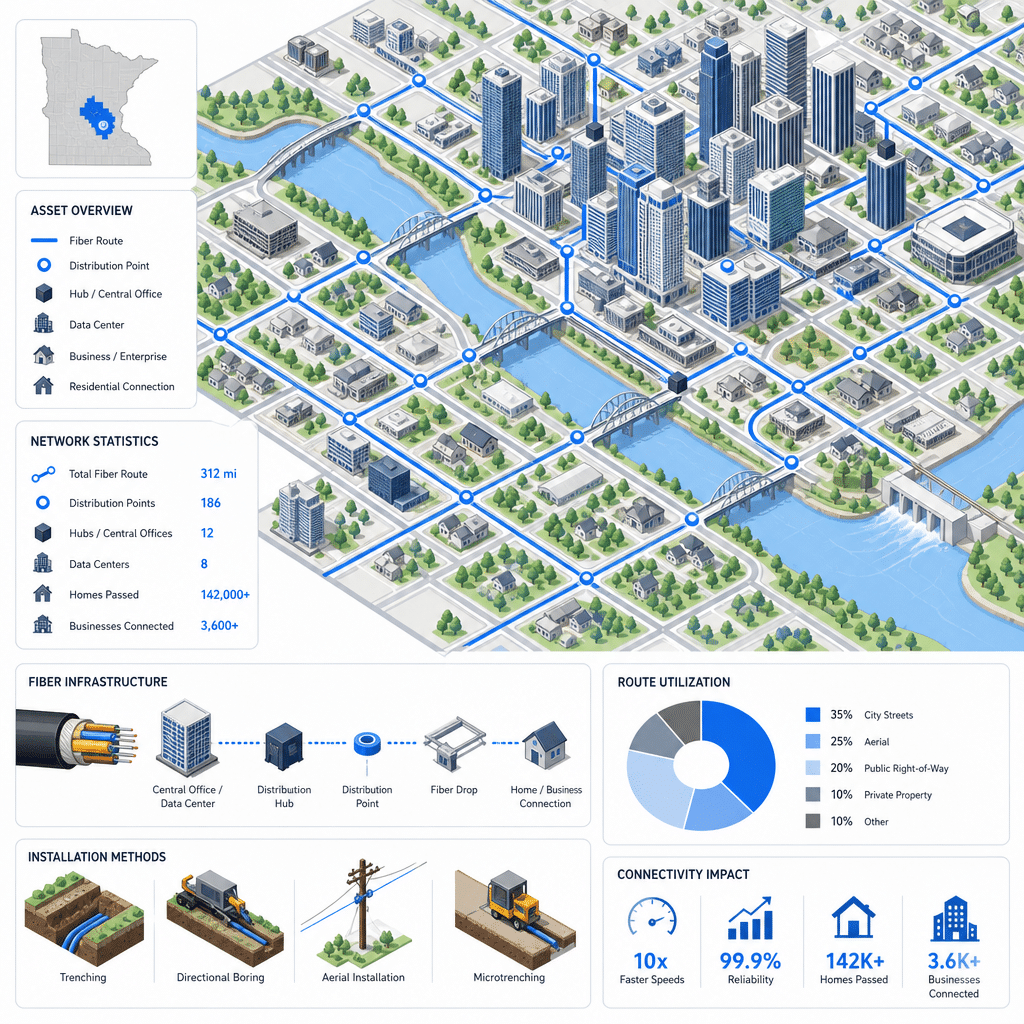
Minneapolis Business Fiber: Key Numbers at a Glance
Sources: ITIC 2024 Hourly Cost of Downtime Survey, Verizon network transformation disclosures, Quantum Fiber Minneapolis business plans, Corning.
The Speed Gap: From 300 Mbps Copper to 8 Gbps Fiber
Business fiber in Minneapolis is available at up to 8 Gbps in select buildings, with 1, 2, and 3 Gig tiers commonly provisioned for mid size offices. That is more than 25 times the throughput a typical 300 Mbps copper plan can deliver on a good day.
Fiber also runs symmetrical upload and download speeds on most business plans. That single change transforms cloud backups, video conferencing, and large file sharing, since copper plans usually cap upload at a small fraction of their download number.
A single optical fiber link can carry more than 50 terabits per second of theoretical capacity, which is why providers describe fiber as effectively future proof. The cable you install today still has headroom when your bandwidth needs triple over the next refresh cycle.
Scalability matters because Minneapolis offices keep adding bandwidth hungry workloads. Backup to the cloud, hosted desktops, security camera retention, and AI tools running on remote GPUs all need symmetric speed and stable latency that copper struggles to deliver.
Downtime Math: What an Hour Offline Actually Costs
Industry research consistently puts the cost of unplanned business downtime in serious territory. ITIC’s 2024 survey found that the average cost of one hour of downtime now exceeds $300,000 for more than 90% of mid size and large enterprises.
Smaller firms are not insulated either. Independent surveys report that 57% of SMBs with 20 to 100 employees estimate downtime at roughly $100,000 per hour, a figure that lands as a working benchmark for a typical Minneapolis professional services firm.
Copper networks are a major contributor to that exposure. They corrode, absorb moisture, and degrade under environmental stress, which forces repeated truck rolls and outages that a properly installed fiber plant simply does not produce at the same rate.
Local fiber networks are engineered for 99.9% uptime as a baseline service level . A single avoided outage usually pays for the upgrade outright, which is the math local IT directors are running when they greenlight a cable installation project
.
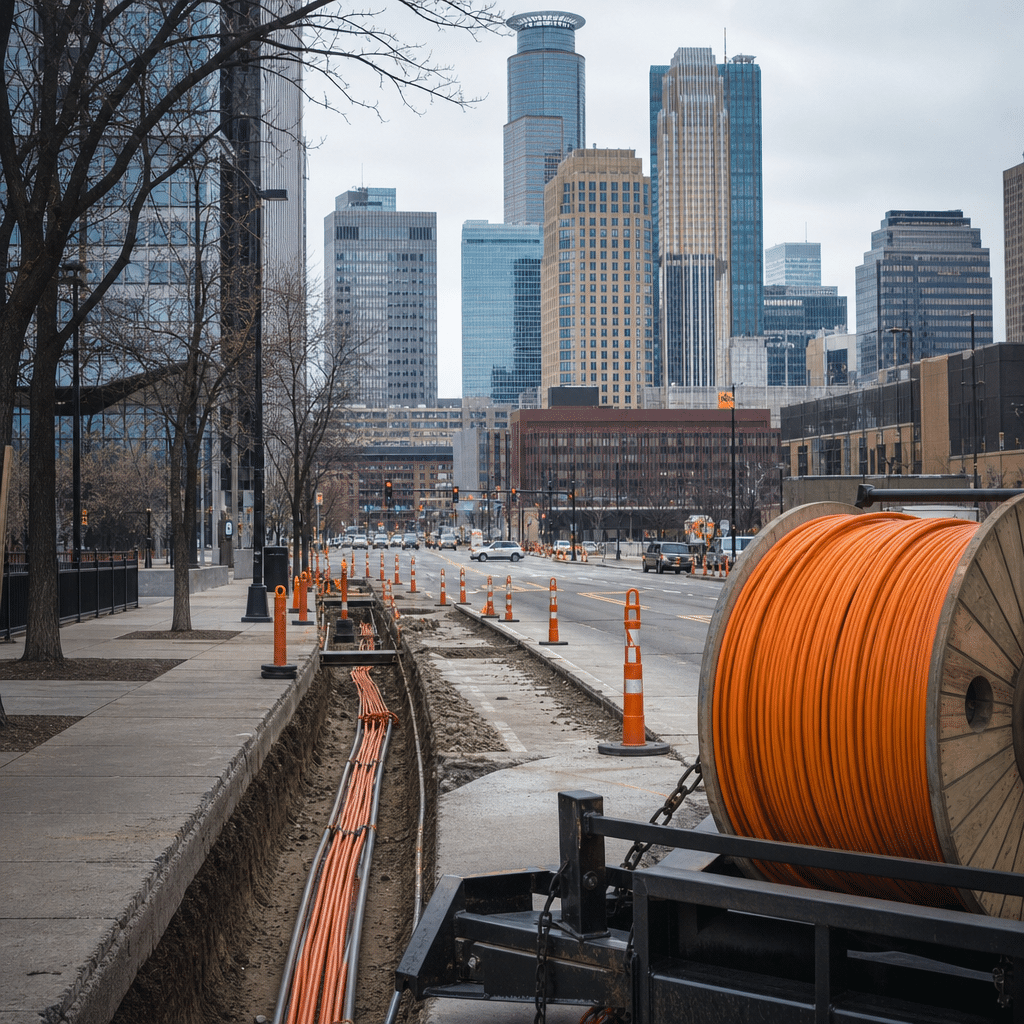
ROI Lessons from Large Scale Copper to Fiber Migrations
The clearest data point on fiber economics is Verizon’s network transformation program. The company migrated 4.5 million circuits from copper to fiber and reports roughly $180 million in annual operating savings
.
Most of those savings come from two places: fewer maintenance dispatches and lower energy use. Fiber conversion alone cut maintenance dispatches by about 60% across Verizon’s footprint, and 36 central offices have been fully retired.
AT&T tells a similar story on the energy side. The company estimates its copper to fiber transition saved roughly 340,000 megawatt hours of electricity in 2024 alone, and Altafiber reports copper service consumes 172 kWh per subscriber annually versus only 6 kWh for fiber.
Those carrier numbers translate directly to enterprise economics. The same physics that saves Verizon money on truck rolls saves a Minneapolis manufacturer on internal maintenance, HVAC load in the telecom closet, and after hours emergency calls.
Industries Driving Fiber Adoption Across the Twin Cities
Minneapolis hosts more Fortune 500 companies per capita than nearly any major American metro, including UnitedHealth Group, Target, 3M, and Best Buy. The supporting ecosystem of medical device firms, financial services, and professional services shares the same connectivity profile: heavy cloud workloads, frequent video, and large file transfers.
Medical and dental practices have moved imaging, EHR, and billing to cloud and hybrid cloud platforms. A single CT or MRI scan can run hundreds of megabytes, and an upload that takes 20 minutes on copper turns into seconds on a symmetrical gig fiber line.
Financial services firms in downtown Minneapolis and the North Loop have an even sharper sensitivity to latency and outages. Published industry estimates place banking and finance downtime at roughly $12,000 per minute, which is why those networks are usually the first to migrate to fiber.
Manufacturers and logistics operators with sites along the I-94 and I-494 corridors are upgrading to support sensor data, machine vision, and real time inventory feeds. The 2024 Siemens analysis pegs average American manufacturer downtime at roughly $260,000 per hour per plant, which is enough to fund a full fiber upgrade after a single avoided incident.
What a Professional Fiber Optic Cable Installation in Minneapolis Looks Like
A real install starts with a site survey, not a quote. The crew walks the building, maps existing conduit, checks the demarc location, and confirms the carrier’s nearest fiber point of presence.
From there the project breaks into three phases: outside plant, building entry, and interior cable plant. Outside plant covers the run from the street or pole to your building, building entry handles conduit and the demarc, and interior plant covers risers, intermediate distribution frames, patch panels, and the cable runs to each workstation or wireless access point.
Most Minneapolis offices need a mix of single mode fiber for backbone runs and OM4 or OM5 multimode for shorter horizontal runs. The right cable type depends on distance, switch optics, and whether the building plans to run 10 Gig, 40 Gig, or 100 Gig in the next refresh.
Permitting and right of way coordination matter more than most owners expect. Working with an installer that already has relationships with Minneapolis Public Works, the property manager, and the major Twin Cities carriers shortens the timeline significantly.
How to Plan a Minneapolis Fiber Upgrade Without Surprises
Start with a written bandwidth forecast that goes 24 months out. Look at current peak utilization, add planned headcount and new applications, and target a service tier that leaves at least 40% headroom on day one.
Get pricing from at least two carriers and confirm fiber availability at your exact address. Provider footprints in Minneapolis are dense but not uniform, and the building next door may have very different options than yours.
Insist on a structured cabling standard for the interior. TIA-568 compliant work with labeled patch panels and a documented as built drawing prevents the rework that turns a clean install into a recurring problem six months later.
Plan the cutover for a low traffic window and run the old circuit in parallel for at least 30 days. The cost of keeping copper alive during transition is small compared to the cost of a failed cutover on a Monday morning.
Frequently Asked Questions
How long does a typical fiber optic cable installation in Minneapolis take?
For a single tenant office under 25,000 square feet, expect 4 to 8 weeks from signed contract to live service. Larger sites or installs that require new outside plant from the street can run 10 to 16 weeks depending on permits, building access, and carrier construction queues.
Is fiber really more reliable than the copper internet we have today?
Yes, by a meaningful margin. Local Minneapolis fiber networks are engineered for 99.9% uptime, and Verizon documented roughly 60% fewer maintenance dispatches on its converted fiber plant compared with the copper it replaced
.
What speed should a 50 person Minneapolis office actually buy?
Most 50 person offices land between 1 Gbps and 3 Gbps symmetrical, with 1 Gbps typical for professional services and 2 to 3 Gbps for firms doing video production, large CAD files, or heavy cloud backups. The right number is whatever leaves at least 40% headroom over your current peak utilization.
Can we keep our existing phone numbers and copper lines during the cutover?
Yes. Numbers port to VoIP or hosted voice without any change to your dialing plan, and most projects run copper and fiber in parallel for 30 to 60 days so users and devices can be migrated in waves.
How much should a Minneapolis business budget for a fiber installation?
Monthly service typically runs $300 to $1,500 for 1 to 3 Gbps business fiber depending on carrier and contract term. One time installation costs vary widely with building access and conduit work, but most single building projects fall between $5,000 and $40,000 turnkey.

About the author
Steve Dempsey - Owner
Steve Dempsey is the owner of Switchback Systems, a Minneapolis PBX and VOIP phone-system specialist that has supported local businesses for over 20 years across brands like Vertical, Avaya, and Nortel.
