

This guide breaks down what you need to know before you switch, from 911 regulations to cabling infrastructure, so you can plan with confidence.
Key takeaways from this article:
- New PBX or multiline telephone systems purchased after December 31, 2004 must provide a callback number and emergency response location to direct first responders accurately.
- Remote maintenance and training capabilities should be evaluated before migration, especially for multi-site businesses and organizations with distributed teams like churches.
- Network infrastructure must be assessed for switch capacity, VLAN readiness, and cabling quality to support voice traffic without degradation.
- Specialized requirements such as property management system integration, call recording, and mobile application support should be mapped before selecting a solution.
- Vendor documentation of compliance configuration in writing provides liability protection and proof of statutory adherence.
Minnesota 911 Laws: The Compliance Gap Most Businesses Miss
Every owner and operator of a multistation or private branch exchange must design and maintain the system so it can dial 911 without charge to the caller.
Under Minnesota law, new PBX or multiline telephone systems purchased after December 31, 2004 must be designed and maintained to provide a callback number and emergency response location, or equivalent means of directing responders to the caller.
Businesses with multiple floors, remote offices, or hybrid work arrangements face particular complexity in maintaining accurate emergency response locations for every possible calling endpoint.
We map emergency response locations to individual extensions, validate callback number accuracy, and document the configuration for compliance review.
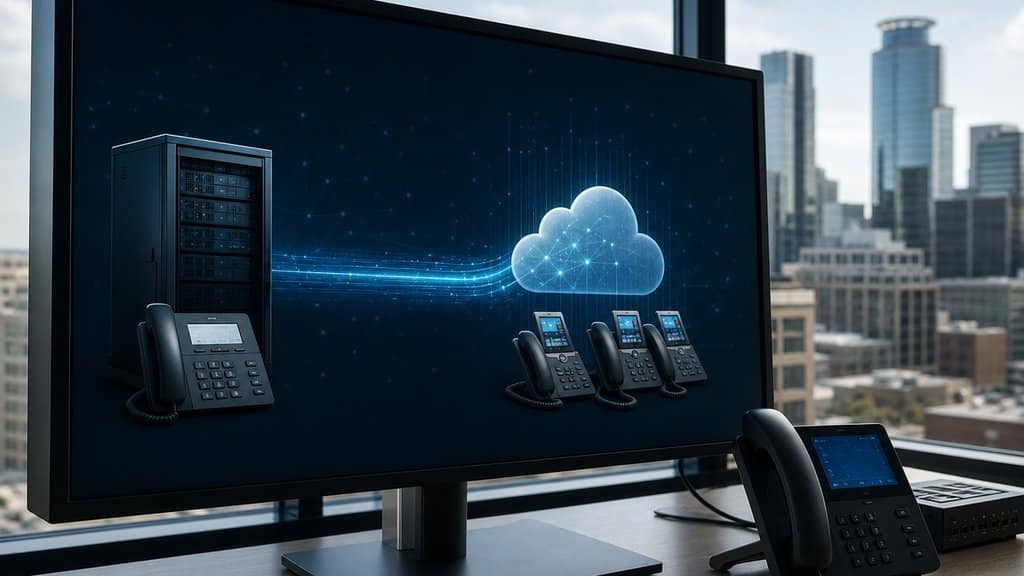
PBX to VoIP Migration Readiness Checklist for Minneapolis Organizations
- ✓Verify 911 dialing works without charge from every endpoint: Required by Minnesota statute for all PBX and multiline systems
- ✓Confirm callback number and emergency response location are configured: Required for systems purchased after December 31, 2004
- ✓Validate 911 capabilities are preserved or enhanced, not reduced: Ensures life safety systems are not degraded during migration
- ✓Assess cabling infrastructure for Cat6 or better quality: Cat6 delivers superior speed and bandwidth versus older Cat5
- ✓Conduct network assessment for switch capacity and VLAN readiness: Identifies weaknesses and optimizes performance before migration
- ✓Document compliance configuration in writing from your vendor: Liability protection and proof of statutory adherence
- ✓Evaluate need for remote maintenance and training capabilities: Critical for multi-site, church, and distributed organizations
- ✓Map specialized requirements: hotel PMS integration, call recording, mobile apps: Prevents operational disruption in environments with complex workflows
Use this checklist during vendor evaluation to ensure your Minneapolis organization’s PBX to VoIP migration meets regulatory requirements and operational needs.
Legacy PBX Support: When Replacement Is Not the Immediate Answer
Not every PBX system needs to be ripped out and replaced. For some businesses, a phased migration or hybrid approach makes more financial and operational sense than a wholesale swap.
This is where vendor neutrality matters. Switchback Systems evaluates each installation on its actual condition and the client’s business timeline, not a one-size-fits-all replacement quota.
Specialized Environments: Hotels, Churches, and Multi-Site Operations
Hotels require phone systems that integrate with property management systems, support wake-up calls, and handle guest room billing with precision. Switchback Systems provides hotel phone system installations and upgrades designed for hospitality workflows.
Churches and religious organizations present another specialized case. Switchback Systems offers remote maintenance and training service for phone systems tailored to church clients, including unified telephony options that connect sanctuary, office, and classroom environments.
The user portal and recording interface we provide enhances phone system functionality for sermon recording, volunteer coordination, and event management.
Multi-site businesses across the Twin Cities metro face the challenge of maintaining consistent emergency response location data across geographically distributed endpoints.

Planning Your Migration: A Practical Minneapolis Business Checklist
Confirm the proposed system meets Minnesota 911 dialing, callback number, and emergency response location requirements for every endpoint. Validate that the vendor will document this compliance in writing and assume liability for configuration accuracy.
Assess your network infrastructure honestly, including cabling quality, switch capacity, and internet bandwidth. If your building still runs Cat5 or mixed cabling, budget for structured cabling upgrades as part of the project scope, not a surprise add-on.
Evaluate whether your organization needs specialized features like hospitality integrations, call recording, remote worker mobile apps, or multi-site unified dial plans.
Finally, consider whether a full replacement or phased migration better suits your operational tolerance for change. Switchback Systems designs both approaches for Minneapolis businesses, with transparent guidance on trade-offs rather than a default recommendation for maximum disruption.
Bandwidth Reality: What Minneapolis Internet Can Actually Handle
Many Minneapolis businesses assume their existing internet connection will automatically support VoIP. The truth depends on concurrent call volume, upload speed consistency, and whether other cloud services already saturate the connection.
A typical VoIP call requires roughly 100 Kbps in each direction when using standard compression. Ten simultaneous calls demand at least 1 Mbps of dedicated, stable upload capacity without competition from file backups or video conferencing.
Cable internet in Minneapolis often advertises high download speeds while upload remains asymmetrically limited. Fiber connections through US Internet or CenturyLink fiber offer more balanced performance for voice traffic.
Jitter and packet loss matter more than raw bandwidth numbers. A 50 Mbps connection with 2% packet loss delivers worse call quality than a 10 Mbps line with clean, consistent throughput.
Businesses in older Minneapolis buildings should verify whether their wiring supports the modem placement needed for optimal router positioning. Poor Wi-Fi coverage forces voice traffic onto congested wireless channels.
Quality of Service configuration on routers prioritizes voice packets above Netflix streams or Windows updates. Most consumer-grade equipment lacks robust QoS, making business-class networking hardware a worthwhile investment.
Switchback Systems tests actual call capacity during business hours rather than relying on speed test snapshots. Real-world validation prevents surprises when Monday morning call volume spikes hit the new system.
Power Outage Preparedness: Keeping Phones Alive When the Grid Fails
Traditional PBX systems often kept working during power outages because copper lines carried their own electrical current. VoIP depends on powered network equipment, creating vulnerability that Minneapolis businesses must deliberately address.
Battery backup units protect individual desk phones for limited durations. Strategic placement of UPS devices at critical workstations maintains basic communication through brief interruptions common during Minnesota thunderstorms.
PoE switches centralize power delivery to phones through ethernet cables. A single commercial-grade UPS protecting the switch can sustain dozens of endpoints simultaneously, simplifying backup infrastructure.
Cellular failover routers automatically redirect voice traffic through LTE or 5G when wired internet fails. This approach maintains full system functionality rather than just keeping a few lines alive.
Generator integration extends protection indefinitely for organizations that cannot tolerate any downtime. Medical practices, property management companies, and critical manufacturers in Minneapolis increasingly require this level of resilience.
Cloud-hosted VoIP platforms continue processing calls even when the local office loses power entirely. Calls route to mobile apps or alternate locations, preserving customer accessibility without local infrastructure investment.
Switchback Systems designs redundancy layers matched to each client’s operational tolerance and budget. Not every business needs generator backup, but every business should understand their exposure and make informed choices.
User Adoption: The Human Side of Technology Transition
Technical migration completes only when actual people comfortably use the new system. Minneapolis businesses frequently underestimate the training and change management required for VoIP adoption success.
Desk phone interfaces differ substantially between manufacturers. Employees accustomed to legacy button layouts encounter learning curves even with functionally superior equipment, temporarily reducing productivity.
Softphone applications on computers and smartphones extend capabilities but introduce unfamiliar workflows. Workers who never previously managed presence status or digital voicemail now face new expectations.
Call handling habits formed over years do not disappear overnight. Receptionists especially need patient, repeated practice with transfer sequences, park orbits, and paging functions before confidence develops.
Recorded training sessions accommodate shift workers and future new hires without requiring repeated live sessions. Switchback Systems provides these resources specifically for Minneapolis clients with complex staffing patterns.
Department champions who learn the system first become peer resources. Internal advocacy proves more effective than external training alone because colleagues trust colleagues who understand actual daily demands.
Post-migration check-ins at 30 and 90 days catch developing issues before they calcify into permanent workarounds. Proactive outreach transforms potentially frustrated users into satisfied advocates who maximize system capabilities.
Integration Opportunities: Connecting Voice to Business Systems
VoIP in Minneapolis represents more than cheaper calls. Modern platforms integrate with operational tools that PBX systems simply cannot touch, creating workflow efficiencies many businesses initially overlook.
CRM synchronization displays customer records automatically when calls arrive. Sales and service teams at Minneapolis manufacturers and distributors gain immediate context without manual number lookups.
Microsoft Teams integration unifies communication channels many employees already use daily. Voice becomes one modality among chat, video, and file collaboration rather than a separate, siloed system requiring distinct habits.
Call analytics reveal patterns invisible to legacy systems. Peak volume timing, abandoned call rates, and average handle times inform staffing decisions with objective data rather than managerial intuition alone.
Automated post-call surveys capture immediate customer feedback without additional staff effort. Simple star ratings or transcription-based sentiment analysis replace quarterly guesswork with continuous measurement.
Hospitality and healthcare scheduling systems can trigger automatic appointment reminders through voice calls. Minneapolis hotels and clinics reduce no-shows while freeing staff from manual notification tasks.
Switchback Systems evaluates each client’s existing software ecosystem before recommending specific integration paths. Meaningful connectivity requires understanding actual business processes rather than installing generic connectors that sit unused.
Frequently Asked Questions
Why does cabling matter for a phone system that runs over the internet?
Cat6 cabling provides superior speed and bandwidth compared to Cat5, with better shielding against interference that matters when voice and data share network infrastructure.
Do you provide remote support after the migration is complete?
Yes. Switchback Systems offers remote maintenance and training for phone systems, including specialized support for church clients and multi-site organizations.
Our user portal and recording interface extends system functionality without requiring on-site visits for every adjustment.
What areas around Minneapolis does Switchback Systems serve?
We serve Minneapolis, St. Paul, Hennepin County, Chisago County, and the broader Twin Cities metro area, including Bloomington and Roseville. Our team provides on-site support and structured cabling throughout this region.
How long does a typical PBX to VoIP migration take?
Timelines vary based on organization size, network readiness, and whether a phased or full replacement approach is chosen. A structured assessment determines realistic scheduling.
Can existing phone numbers be kept when switching to VoIP?
Number portability is standard practice. The process requires coordination with carriers and proper timing to avoid service gaps during cutover.
What happens to old PBX hardware after migration?
Disposition options include recycling, resale, or secure disposal. Switchback Systems advises based on equipment condition and data security requirements.
