

When a Minneapolis business plans a network refresh in 2026, the cabling choice between fiber optic and copper drives almost every downstream decision around speed, cost, and how long the build will last. Switch ports, ISP handoffs, PoE budgets, and even the layout of your IDF closets all hinge on getting this fundamental decision right the first time.
SWB specializes in fiber optic installation in Minneapolis MN, and we run hybrid copper and fiber projects every week from the North Loop to Northeast and out into the surrounding business districts. This guide breaks down the real bandwidth, distance, installation cost, and future-proofing tradeoffs so your team can plan with numbers and named scenarios instead of vendor marketing.
Key takeaways from this article:
- Fiber backbones in Minneapolis now support symmetrical multi-gig business plans from 2 Gig up to 8 Gig from providers like Quantum Fiber, while copper LAN runs are practically limited to 1 Gbps to 10 Gbps over 100 meters or less.
- Cat6 and Cat6a copper remain the right cable for office drops, VoIP, and Wi-Fi access points because most powered endpoints need Power over Ethernet, which fiber alone cannot deliver.
- Fiber installs require fusion splicing, OTDR testing, and certified technicians, so specialized crews price these projects at roughly 200 to 450 dollars per fiber termination versus 150 to 300 dollars for a typical Cat6a drop in 2026.
- Most modern Minneapolis offices end up on a hybrid design where fiber carries the ISP handoff and backbone, and Cat6a handles the final 100 meters to user devices.
Why the Fiber vs. Copper Question Matters for Minneapolis Businesses in 2026
Minneapolis business districts have changed faster than most existing cabling plans can keep up with, especially over the last three years. Quantum Fiber, CenturyLink, AT&T Fiber, and Mediacom are pushing symmetrical multi-gig service into the North Loop, Downtown, Northeast, Uptown, and outlying neighborhoods at a pace that is reshaping what counts as a baseline office network.
If your existing copper plant tops out at 1 Gbps on aging Cat5e, a new 5 Gbps or 8 Gbps ISP handoff at the demarc cannot reach the rest of your stack without serious bottlenecks at every uplink. That is the exact gap most 2026 cabling refresh projects across the Minneapolis metro are designed to close.
The decision is rarely fiber or copper as a strict either-or for a real office network. It is which medium goes where in the building, what each layer costs to install correctly, and how each one scales when your team doubles in size or signs onto a cloud-heavy workflow that triples upload demand.
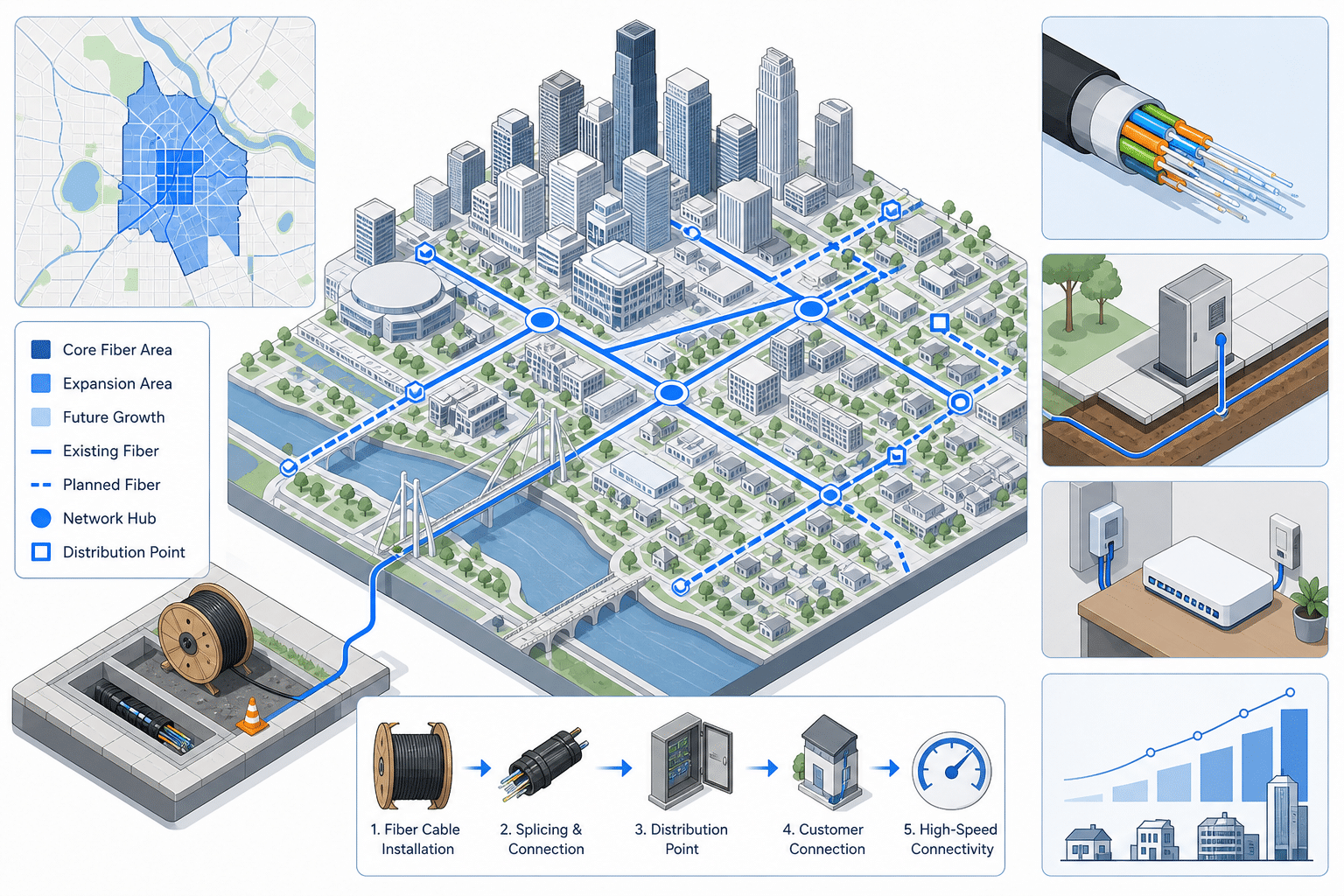
Bandwidth and Distance: What Each Cable Type Actually Delivers
Single-mode fiber backbones routinely carry 10 Gbps, 40 Gbps, and 100 Gbps over thousands of meters with only a transceiver swap at each end, no recabling required. A single pair of OM4 multimode fibers can support 10GbE, 40GbE, and even 100GbE with the right transceivers, while single-mode fiber is virtually limitless in bandwidth capacity, which is exactly how providers like Quantum Fiber scale Minneapolis business plans from 2 Gig to 8 Gig on the same physical strand.
Copper cabling, by contrast, is capped by physics in ways no installer can engineer around. Cat6 supports 10GBASE-T up to 55 meters, and Cat6A supports it up to 100 meters, with Cat6a getting there thanks to thicker shielding and tighter twist rates.
Most real Minneapolis office deployments still provision Cat5e and Cat6 drops well under 1 Gbps because the attached devices, VoIP handsets, label printers, badge readers, and standard workstations, do not need more than a fraction of that bandwidth. The bottleneck is rarely the individual wire, it is usually the uplink, the aggregation switch, or the wireless backhaul to the core.
If your cable run exceeds 100 meters or crosses between buildings, standard Ethernet over copper is no longer rated for the job, and you must either add active repeaters and media converters or move to fiber. Fiber handles those distances natively, stays immune to the electromagnetic interference common in mechanical rooms and elevator shafts, and ignores grounding mismatches between separate buildings.
Real-World Use Cases We See Across Minneapolis Networks
Across our Minneapolis cabling projects, fiber almost always carries three specific jobs in the design: the ISP handoff at the demarc, vertical risers between floors of the same building, and any link that joins two buildings on a shared campus or parking lot. Anything longer than the 328 foot copper limit moves onto single-mode fiber by default, no exceptions.
Copper still owns the work area inside the building. A hybrid network is the standard design for modern offices, utilizing fiber for long-distance switch interconnections and Cat6A for the final 328 feet to devices, which is exactly how a typical 50-person office in the Warehouse District is built.
Power over Ethernet is the single biggest reason copper survives at the access layer. Cat6A is the only cable that delivers PoE++ up to 90W to power Wi-Fi 7 access points and PTZ cameras, which fiber cannot do, so any powered endpoint stays on copper by default.
Mediacom and CenturyLink customers in the Metro Minneapolis upgrade footprint are already seeing handoffs that push 2 Gbps and beyond into their buildings. A copper backbone built before 2020 on aging Cat5e simply will not pass that traffic cleanly up to a third-floor switch, even if every patch panel and jack is in perfect condition.

Installation Complexity and What to Expect from a Qualified Crew
Copper cabling is the work most IT teams are already comfortable scoping and buying. Pulling Cat6a through ceilings and conduit, terminating to a 110 punch-down panel or keystone RJ-45 jack, and certifying every drop with a Fluke DSX tester is a well-understood service in every Minneapolis structured cabling shop.
Fiber is a different discipline that rewards specialization. Termination usually requires fusion splicing or a high-quality field-installable connector, and every link should be certified with an OTDR trace and an optical light meter to confirm that insertion loss falls inside the design budget.
That technical lift is why fiber optic installation in Minneapolis MN costs more per drop and demands trained technicians who carry the right test gear. In 2026, Cat6A installation typically costs 150 to 300 dollars per drop, while fiber optic runs range from 200 to 450 dollars or more depending on termination type, with switch optics adding more cost on top.
Ask any prospective vendor for a sample test report before you sign a statement of work. A real fiber installer will hand you OTDR traces in both directions, an insertion loss summary against design budget, and a Tier 1 or Tier 2 certification package per strand, plus continuity and length data for every copper drop.
Future-Proofing: Where Fiber Wins and Where Copper Holds Its Own
Fiber’s single biggest long-term advantage is upgrade headroom on the same physical cable. Fiber infrastructure has a much longer operational lifespan, and the ability to upgrade speeds simply by replacing transceivers rather than recabling saves enormous costs in the long run.
Copper does not work that way at higher speeds. Stepping a building from 1 Gbps to 10 Gbps usually means ripping out aging Cat5e or early Cat6 and replacing it with Cat6a, plus revalidating bend radius, bundle separation, and grounding on every run, often during after-hours work.
Copper still wins on the dollars-per-port math at the access layer for short runs to powered devices. As long as your endpoint speeds stay under 10 Gbps and your runs stay under 100 meters, Cat6a remains the practical choice and will continue to be for the foreseeable refresh cycle.
The smart 2026 strategy is to invest in fiber where you cannot easily re-pull cable later: vertical risers between floors, underground conduit between buildings, and the entire path from the demarc to your main core switch. Put copper where you expect to add, move, or replace devices regularly, such as the open office area, conference rooms, and reception.
Service Availability and ISP Handoffs in Minneapolis Business Districts
Minneapolis now has a deep bench of fiber-capable ISPs, with 10 fiber providers among the 19 internet providers serving Minneapolis, and Quantum Fiber and AT&T Fiber leading the symmetrical multi-gig business segment. Quantum Fiber offers multi-gig internet plans in select locations with speeds of up to 2 Gig, up to 3 Gig, and even up to 8 Gig across Minneapolis neighborhoods.
Coverage is still very address-specific in this market. Two buildings on the same block can have completely different fiber options at the demarc, which is exactly why we recommend a serviceability check during early design planning rather than after the cabling layout is already finalized.
Copper-based DSL still exists across the Minneapolis metro but is constrained by distance to the central office and is generally capped well below 1 Gbps in real-world delivery. For any business serious about cloud workloads, hosted VoIP, large file transfers, or modern collaboration tools, DSL is not a long-term answer on the WAN side.
Mediacom is also actively bringing multi-gig and symmetrical speed broadband to one million homes and businesses by the end of 2026, with upgrade projects underway in its Metro Minneapolis market. Together with Quantum Fiber’s 2 Gig through 8 Gig business plans, Minneapolis businesses finally have real, competitive options for symmetric uploads, which is a meaningful shift from the asymmetric cable plans that dominated past years.
How to Choose: A Decision Framework for Minneapolis IT Leaders
Start every cabling decision with three questions: how far does the cable need to run end to end, what bandwidth will you need three to five years out, and does the endpoint need Power over Ethernet to operate. The honest answers to those three questions point cleanly to fiber, copper, or a planned combination of both.
If the run is over 100 meters, crosses buildings, passes through high-EMI mechanical spaces, or aggregates uplink traffic from multiple switches, fiber is the correct call every time. If the run is short, terminates at a powered device like a phone or access point, and needs to be easy for a generalist IT tech to repatch on a Saturday, Cat6a copper is the correct call.
Budget for both layers in the same project rather than splitting the work into phases. A hybrid plan with fiber backbone and Cat6a access typically costs less over a ten-year horizon than two separate cabling efforts scheduled years apart, because pathway access and after-hours labor are the most expensive parts of the bill.
Document everything as you build. Label both ends of every strand and every drop with matching jack and panel IDs, store test reports and as-builts in a shared location your team can find in three years, and keep a small inventory of spare patch cords, SFP modules, and keystone jacks on site for fast swaps.
Frequently Asked Questions
Do I need to run fiber to every desk in my Minneapolis office?
Almost never. For most Minneapolis offices, fiber goes to the demarc and between IDF closets, and Cat6a copper runs from each closet to desks, phones, access points, and cameras.
The exception is a specialty workstation that needs sustained 10 Gbps or more, such as a video editing bay or a large dataset analytics rig.
How much does fiber optic installation in Minneapolis MN typically cost?
Fiber termination usually runs about 200 to 450 dollars per drop in 2026 depending on whether you are using LC, SC, or MPO connectors and whether the run requires fusion splicing. A full backbone project that includes pathways, conduit, splicing, OTDR certification, and SFP modules will generally land in the low to mid five figures for a typical small to mid-size office.
Pricing varies with building access, ceiling type, and after-hours requirements, so a walk-through quote is always more accurate than a rule of thumb.
Will copper cabling still meet my needs if I subscribe to a 2 Gig or 5 Gig fiber business plan?
Yes, if your internal copper plant is Cat6a or better and your switches have 10 Gbps SFP+ uplinks to the core. If you are still on Cat5e or older Cat6 backbones, you will lose most of the value of a multi-gig plan because the LAN becomes the bottleneck before the data ever reaches a user.
How long does a fiber backbone install take for a typical Minneapolis office?
For a 10,000 to 30,000 square foot space, expect roughly one to two weeks from kickoff to certified handoff. That window includes pathway prep, pulling, splicing, OTDR testing, and labeling, assuming building access is straightforward and electrical work for the network closets is already complete.
Larger campuses or multi-building runs add time for permits, conduit, and outdoor work.
Can I add fiber later if I just install copper now?
You can, but it usually costs more than including both layers in the original project. Pathway access, after-hours work, and disruption to a live production network make a phase-two fiber pull two to three times the labor of a clean install during initial cabling.
If fiber is even possible in your five-year plan, pull dark strands now while the ceilings are open.

About the author
Steve Dempsey - Owner
Steve Dempsey is the owner of Switchback Systems, a Minneapolis PBX and VOIP phone-system specialist that has supported local businesses for over 20 years across brands like Vertical, Avaya, and Nortel.
