
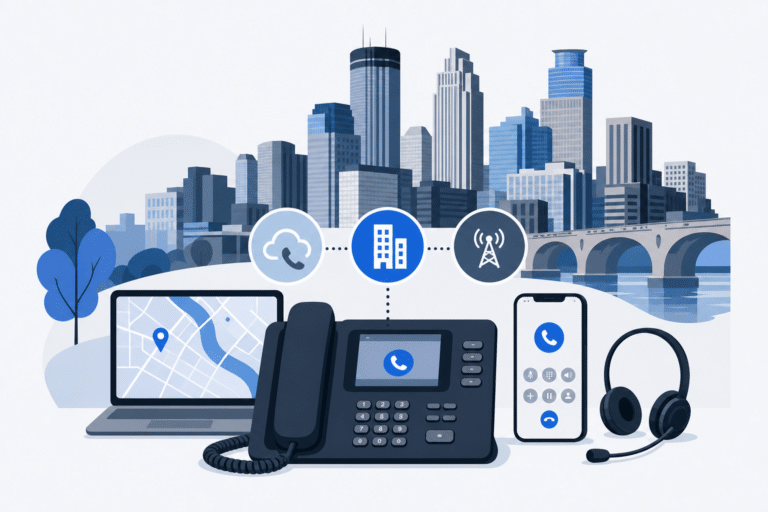
When your Minneapolis office picks up the phone and nothing happens, the cost is measured in lost appointments, missed quotes, and frustrated clients calling the next vendor on their list. Choosing the right business phone service in 2026 is now more about uptime, feature depth, and local number coverage than the headline monthly price.
This guide walks through the realistic options for business phone services in Minneapolis, from $8.99 budget VoIP plans to enterprise UCaaS with AI-powered features. We break the local market into a scorecard so you can match a service model to your team size, call volume, and tolerance for downtime.
Key takeaways from this article:
- Minneapolis business VoIP pricing spans a wide range, from $8.99 per month entry plans to roughly $38.86 per month at the market average, with enterprise tiers quoted custom.
- Five service models cover almost every local need: VoIP, Cloud PBX, SIP trunking, UCaaS, and traditional landline or analog as a backup.
- Local number coverage in the Twin Cities runs across four area codes, 612, 952, 763, and 651, and not every national provider can provision in all four.
- If your business cannot afford internet-dependent outages, a Minnesota landline is still available as a redundancy line and worth scoring against your VoIP shortlist.
Why Minneapolis Businesses Are Rethinking Phone Service in 2026
Minneapolis runs on small and mid-size offices that depend on the phone for first contact: clinics in Uptown, law firms downtown, contractors in Northeast, and retailers along Nicollet Mall. When the phone line goes quiet for an hour, the dollar cost shows up as missed quotes, abandoned appointment bookings, and unhappy regulars who simply call the next vendor.
The 2026 market is no longer split cleanly between an old copper landline and a new VoIP plan. Almost every provider now sells some flavor of cloud phone, but feature depth, advertised uptime, mobile app quality, and Twin Cities area code coverage vary widely from vendor to vendor.
Buyers also have to factor in remote work patterns, SMS for customer messaging, AI call summaries, and direct CRM integration with tools like HubSpot or Salesforce. A 2018 shortlist of providers is no longer the right 2026 shortlist, which is exactly why a fresh side-by-side comparison is worth doing this year.

The Five Service Models You Can Buy in Minneapolis Today
Local vendors in Minneapolis and the broader Twin Cities offer five core service models that any reasonable shortlist should evaluate. Each has a different cost profile, feature ceiling, and failure mode you should understand before signing a contract.
VoIP is the most common pick for small offices because it runs over your existing internet and is sold on a simple per user, per month basis. Cloud PBX is the same idea scaled up, with full PBX features like auto attendant, hunt groups, and multi-site routing delivered as a hosted service rather than a box in your closet.
SIP trunking is built for businesses that already own a PBX and want to keep it while swapping copper lines for an internet-based trunk. UCaaS bundles voice with messaging, video meetings, and collaboration tools and is the modern enterprise pick for teams that want a single platform across phone, chat, and video.
Traditional landline or analog service is still available across Minnesota for buyers who need a phone that works when the internet does not. It is increasingly priced and sold as a redundancy line for elevators, alarm panels, and safety phones rather than as a primary office service.
What Business Phone Services Actually Cost in Minneapolis
Budget VoIP in Minneapolis starts around $8.99 per month from providers like Cebod Telecom, which is a competitive entry point for solo professionals and very small offices . That price usually buys a single line, basic call routing, and a curated feature set rather than the full UCaaS depth a larger team would expect
.
Mid-market per-user VoIP plans in Minneapolis start near $15 per user per month from providers like OpenPhone, with a free local number included and additional numbers priced around $5 per month. This tier is the sweet spot for teams of roughly 3 to 25 users who need shared inboxes, mobile apps, and SMS.
The Minneapolis market average for business VoIP lands at roughly $38.86 per month, which is a useful midpoint when you are sanity checking a vendor quote . Enterprise UCaaS and AI-enabled platforms from providers like Elevated Group sit above that line and are typically quoted custom based on seat count, integrations, and uptime commitments
.
Total cost of ownership also includes phones or headsets, taxes and 911 fees, and any number porting charges. A quote that looks $5 per user cheaper can land in roughly the same place after you add a $200 desk phone for every seat.

Local Area Codes and Number Provisioning in the Twin Cities
Minneapolis and the surrounding metro are covered by four area codes that matter for business: 612 for the city core, 952 for the southwest suburbs, 763 for the northwest suburbs, and 651 for St. Paul and the east metro . Local installers like Phonewire provision across all four, and OpenPhone confirms 612 as the core Minneapolis code
.
If your office sits in Edina, Minnetonka, or Eden Prairie, a 952 number signals to local callers that you are nearby. A 612 number signals downtown or the city proper, which still matters for trust and call-back rates on inbound caller ID.
Not every national VoIP brand can hand you a number in all four Twin Cities codes, so make local area code inventory part of your shortlist conversation. Porting an existing number from a legacy carrier such as CenturyLink or Comcast is also a standard request worth confirming up front, along with the expected porting window.
Feature Depth: What Gets Bundled at Each Price Point
At the $8.99 budget tier, Cebod Telecom advertises 50+ premium phone features, which is unusually deep for that price point in the Minneapolis market . Expect auto attendant, voicemail to email, call recording, ring groups, hold music, and basic IVR to be in scope
.
Mid-market plans typically add mobile and desktop apps, SMS, shared inboxes, light CRM integration, and call analytics dashboards. This is the tier where remote and hybrid Minneapolis teams start to feel a real daily benefit from moving off the old desk phone model.
Enterprise UCaaS adds AI call summaries, transcription, sentiment scoring, deeper analytics, call queue management, and contact center features. Elevated Group, for example, positions its Minneapolis service as enterprise-grade VoIP and UCaaS with AI-powered features bundled into the platform.
When you compare vendors, pull every feature into a single spreadsheet and mark which items are included versus paid add-ons. The cheap-looking plan can quietly become the expensive one once you add call recording, SMS, international minutes, or a second toll-free number.
Reliability, Uptime, and the Internet Outage Question
Uptime is the question that separates a good demo from a good service. Enterprise providers like Elevated Group advertise a 100% uptime claim for their Minneapolis platform, which is worth pressing on during sales calls to understand exactly what counts as covered downtime in the SLA.
Standard VoIP is only as reliable as your internet connection, which means a Comcast Business or CenturyLink Fiber outage takes your phones offline with it. A second internet connection on a different carrier, an LTE failover device, or a softphone app running on cellular all give you a useful fallback.
For businesses that cannot tolerate any internet-related outage, a traditional landline is still available in Minnesota and can sit alongside a modern VoIP plan as a backup. Wirefly’s Minnesota business phone comparison specifically highlights landline as a viable option because it does not require internet to operate.
Power loss is the second failure mode to plan for, because a cloud phone is useless on a dead router. A small UPS on the router, switch, and any desk phones keeps the line alive through short power blips and summer thunderstorms.
How to Match a Provider to Your Business Type
A solo professional or a 1 to 3 person Minneapolis office can usually run on a budget VoIP plan in the $8.99 to $15 per month range and still get auto attendant and voicemail to email . Spend the savings on a quality headset, a business-grade router, and an LTE backup if revenue depends on the phone ringing
.
A 5 to 50 person company benefits from a mid-market per-user plan with mobile apps, SMS, shared inboxes, and CRM integration. Pick a vendor that can provision 612, 952, 763, or 651 numbers based on where your customers actually live and how you want your caller ID to read.
Multi-location, regulated, or call-heavy operations should price out enterprise UCaaS with AI features, redundant SIP trunks, and a defined SLA with credit terms. Pair it with a landline backup or LTE failover if any minute of downtime translates directly into lost revenue or compliance risk.
Whichever tier you choose, ask the vendor for a 30 day trial or a published cancellation policy in writing. A real local provider should be willing to stand behind a short pilot rather than locking you into a multi-year contract on day one.
Frequently Asked Questions
How much does business phone service cost in Minneapolis?
Entry-level VoIP starts as low as $8.99 per month from budget providers like Cebod Telecom, while mid-market per-user plans begin near $15 per user per month from vendors like OpenPhone . The Minneapolis market average lands around $38.86 per month, with enterprise UCaaS priced custom above that line based on seat count and integration
s.
Can I keep my existing Minneapolis phone number when I switch providers?
Yes, number porting is standard across reputable VoIP and UCaaS vendors and usually takes 5 to 15 business days. Confirm the porting timeline in writing before you sign, and do not cancel your current service until the new provider confirms the port is complete.
Do business phones still work in Minneapolis when the internet goes out?
Standard VoIP and cloud PBX rely on your internet connection, so an outage takes them down with it. A traditional landline is still available as a backup option in Minnesota, and many businesses also use an LTE failover device or a softphone app on cellular for redundancy.
Which Twin Cities area codes can a Minneapolis business phone provider give me?
The four area codes that matter locally are 612, 952, 763, and 651, covering Minneapolis, the southwest and northwest suburbs, and St. Paul or the east metro . Local providers like Phonewire provision across all four, while some national brands have inventory in only one or two of the codes
.
What features should a Minneapolis small business expect at the entry price?
Even at the $8.99 tier, providers like Cebod Telecom advertise 50+ premium features including auto attendant, voicemail to email, call recording, ring groups, hold music, and basic IVR . Mid-market plans typically add mobile and desktop apps, SMS, shared inboxes, and light CRM integration
.
