

When a Minneapolis business outgrows its network, the bottleneck is almost never the switches or the servers. It is the cabling in the walls, the plenum, and the telecom room, and replacing it midstream is far more expensive than getting it right the first time.
This guide walks Twin Cities business owners and facility managers through what data structured cabling installation in Minnesota actually includes, from Cat6a copper runs to single-mode fiber backbones. It covers the licensing requirements unique to Minnesota, the testing and documentation you should expect at handoff, and the questions that separate a serious cabling contractor from a discount bidder.
For a deeper look at how Switchback Systems approaches cabling installation across office, warehouse, and campus environments, see our complete guide to network cabling installation in Minneapolis.
Key takeaways from this article:
- Minnesota requires a Power Limited Technician (PLT) license from the Department of Labor and Industry for almost every commercial cabling job, so verify your contractor before signing.
- ANSI/TIA-568 sets the technical baseline for Cat5e, Cat6, Cat6a, and fiber, including a 100-meter horizontal run limit and a Cat6a insertion loss ceiling of 21.3 dB at 100 MHz.
- Fluke copper certification, OTDR and light-source fiber testing, TIA-606 labeling, and as-built drawings should be in the scope of work, not optional add-ons.
- Plan the MDF and IDF rooms, low-voltage bundles for security and AV, and the 24/7 support terms during design, because retrofits in a finished office triple the labor.
Why Minneapolis Businesses Should Treat Structured Cabling as Infrastructure
Minneapolis offices span everything from converted warehouses in the North Loop and Northeast to multi-floor towers downtown and corporate parks in Bloomington, Edina, and Eden Prairie. Each layout pushes the cabling system differently, with older buildings forcing tighter pathway choices around exposed brick and steel and modern Class A space demanding higher-density fiber to the closet.
A structured cabling system is the physical layer that everything else depends on, including VoIP phones, Wi-Fi 6 and 6E access points, security cameras, badge readers, building automation sensors, and networked printers. When the cabling is poorly designed or undocumented, every IT problem takes longer to diagnose and every move-add-change order costs more in labor.
That is why serious Twin Cities providers frame their work as end-to-end design, installation, testing, and documentation rather than just pulling wire. The goal is a system that lasts ten or more years with predictable performance and a clear paper trail for whoever owns IT next.
Done well, the cabling plant becomes invisible to the people who use it every day. Done badly, it surfaces as latency, dropped calls, intermittent printers, and IT tickets that nobody can close cleanly.
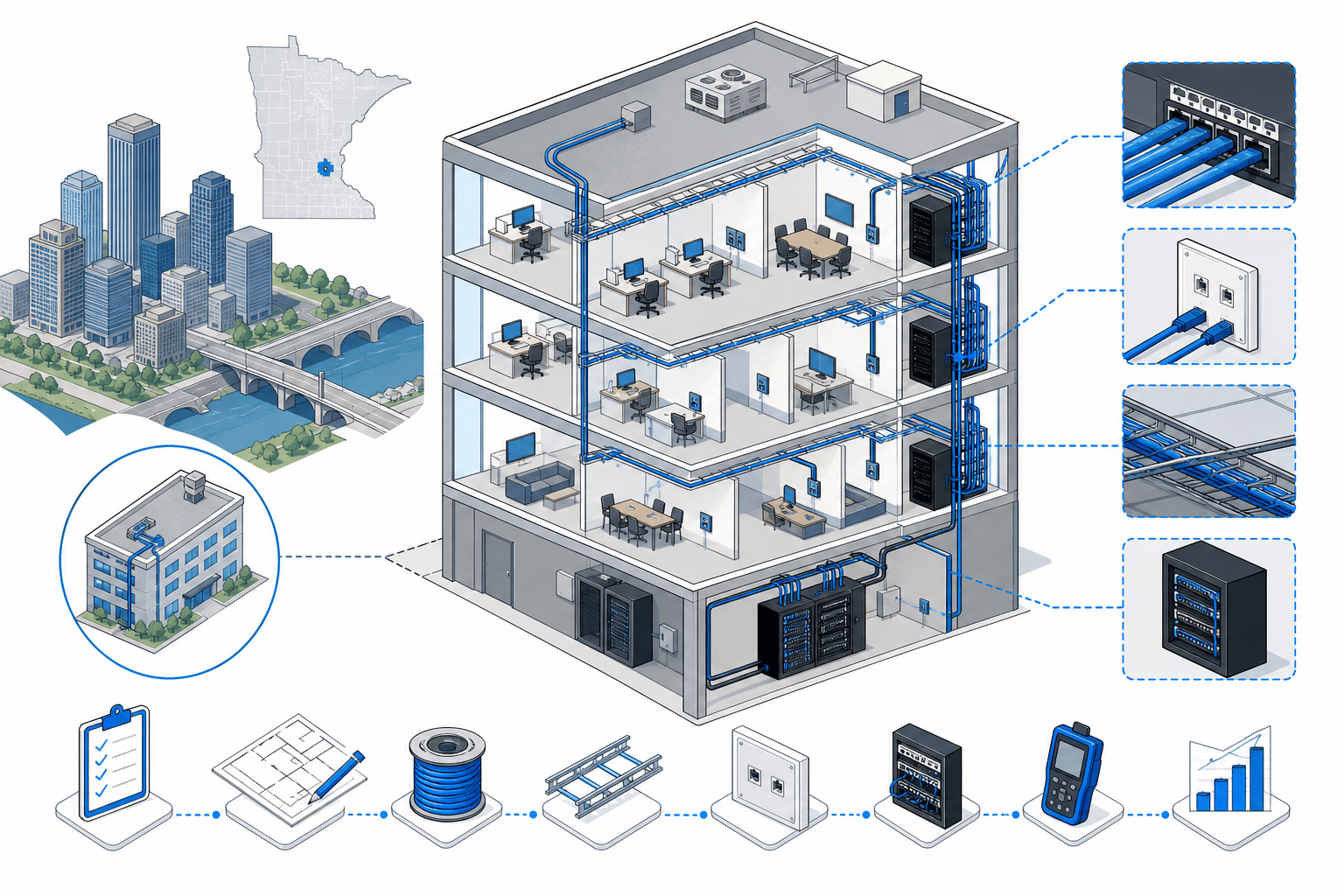
Structured Data Cabling in Minneapolis: Service Scope at a Glance
Scope reflects typical Minneapolis-area structured cabling provider offerings and ANSI/TIA-568 / Minnesota DLI licensing requirements.
What ANSI/TIA-568 Actually Requires for Cat5e, Cat6, and Cat6a
ANSI/TIA-568 is the commercial building cabling standard published by the Telecommunications Industry Association, and the current revision is TIA-568-E, published in 2020. It defines pin and pair assignments (T568A and T568B), cable performance categories, topology, distance limits, and testing methods that every reputable Minneapolis installer should follow.
Cat5e runs at 100 MHz and supports 1 Gbps to the full 100-meter horizontal limit, while Cat6 hits 250 MHz and 10 Gbps but only out to about 55 meters before it drops back to 1 Gbps. Cat6a holds 10 Gbps to the full 100 meters at 500 MHz, which is why it is the default for new construction, PoE-heavy designs, and any cabling intended to live past 2030.
If your project team is still weighing copper options, our detailed breakdown of Cat6 Vs Cat6a covers the bandwidth, distance, and PoE differences that matter most for Minneapolis offices.
The standard also enforces practical rules that quietly protect performance. Bend radius cannot be tighter than four times the cable diameter, and insertion loss for Cat6a must stay under 21.3 dB at 100 MHz across 100 meters or the link will not certify
.
BICSI, the international training body for cabling pros, has documented that buildings using TIA-568-compliant cabling carry roughly 40 percent lower maintenance costs over a ten-year window. That delta comes from fewer signal integrity issues, faster troubleshooting, and a longer useful life before a refresh is needed.
Fiber Optic Backbone, Connectors, and When You Actually Need It
Single-mode fiber (SMF) is built for distance and runs between buildings on a campus or between data centers across town. Multi-mode fiber (MMF) is the workhorse inside a single building, typically OM3 or OM4 between the MDF and each IDF.
Minneapolis providers terminate fiber with ST, SC, LC, or MTRJ connectors depending on equipment age and port density, with LC dominating new builds because it fits twice as many ports in the same patch panel space. Termination quality drives every later performance metric, which is why field terminations should be tested with both a tier-one light source and power meter and a tier-two OTDR.
Multi-mode comes in grades that matter for budgeting. OM3 is rated for 10 Gbps to 300 meters, OM4 carries 10 Gbps to 400 meters or 100 Gbps to about 150 meters, and OM5 adds short wavelength division multiplexing for higher channel counts on the same glass.
The right time to add a fiber backbone is during the original build, not after. Retrofitting fiber risers through a finished six-story office runs three to five times the cost of installing them while ceilings and shafts are still open.

Testing, Certification, and Documentation You Should Insist On
A reputable Minnesota cabling contractor will hand you a Fluke certification report on every copper run, not just a continuity check. Certification verifies insertion loss, return loss, near-end and far-end crosstalk, propagation delay, and skew against the TIA-568 category limits, then stores the result against a unique cable ID.
Fiber gets a separate test stack, typically a tier-one light source and power meter loss test plus a tier-two OTDR trace that locates connectors, splices, and any anomalous events along the run. Both reports should land in your project closeout package alongside photos, labeling schemes, and pathway drawings.
Labeling and as-built drawings come from ANSI/TIA-606, the administration standard. Every jack, cable, patch panel port, and rack location should carry a unique ID that ties to both a printed floor plan and a digital record your IT team can search.
Documentation outlives the people who installed the cabling. When your IT lead moves on or your facility manager retires, the as-builts and certification reports are the only artifact that says how the network was actually built and tested.
Low-Voltage Bundles: Security, Access Control, AV, and Wi-Fi
Most Minneapolis cabling firms now bundle low-voltage work alongside data cabling because the systems share pathways, conduits, and telecom rooms. A typical bundle covers RG-6 coax for cameras, Cat6 or Cat6a for IP surveillance and access control readers, speaker wire and HDMI extension for conference rooms, and dedicated drops for Wi-Fi access points.
Bundling matters for two reasons. First, it cuts labor by 20 to 30 percent versus hiring separate trades, and second, it eliminates the finger-pointing that happens when the camera feed drops and nobody is sure which contractor owns the jack.
Wi-Fi deserves special attention in modern Minneapolis offices. Each Wi-Fi 6 or 6E access point can pull more than 25 watts over PoE, which is why Cat6a is the safe call for AP drops even where Cat6 would otherwise be sufficient.
Conference rooms have their own quirks. HDMI over Cat6 with active extenders is now standard for displays beyond 25 feet, and pulling that cabling alongside the data drops avoids opening the ceiling tiles a second time when the AV vendor arrives.
Minnesota Licensing, MDF/IDF Build-Out, and the PLT Requirement
Minnesota is one of the strictest states in the country for low-voltage licensing. The Department of Labor and Industry requires a Power Limited Technician (PLT) license for almost all commercial structured cabling work, with 36 months of documented field experience under a licensed contractor plus a passing score of 70 percent or higher on the open-book PLT exam.
Ask any prospective cabling vendor for both the PLT license of the supervising technician and the company’s Technology Systems Contractor registration, then verify both on the state eLicense portal. An unlicensed crew can void your insurance, your building permit, and any warranty the manufacturer offers on the components installed.
The MDF (main distribution frame) and IDF (intermediate distribution frame) rooms are where most build-out problems start. Rack layout, patch panel selection, cable management, ladder racks, ground bonding, and cooling all need to be designed before the first cable is pulled, because retrofitting a finished telecom room is one of the most expensive line items in any IT project.
Permitting in the Twin Cities is generally light for standalone structured cabling. Most cities in Hennepin and Ramsey counties do not require a permit for pulling Cat6 or fiber on its own, but anything that penetrates a fire-rated wall, controls line-voltage equipment, or ties into the building electrical system does need one.
Ongoing Support, Maintenance, and What 24/7 Really Costs
Cabling systems rarely die all at once, they degrade in small ways that show up as random Wi-Fi drops, slow phones, printers that disappear from the network, or one camera that keeps rebooting. A maintenance contract with a Minneapolis cabling firm catches these issues before they cascade into a full outage.
Most Twin Cities providers advertise 24/7/365 emergency response, with a typical four-hour on-site window for contract clients and same business day for break-fix calls placed before mid-afternoon. Verify the response SLA, the after-hours rate, and the parts inventory in writing rather than relying on a sales pitch.
Move-add-change (MAC) work is the other half of ongoing support. Reasonable per-drop pricing for adds, plus banked hours for cubicle reshuffles, prevents the surprise invoice that hits when your real estate team decides to redo the floor plan in Q4.
Spare capacity is the unsung hero of long-term support. Pulling an extra 10 to 20 percent of drops during the initial install, plus leaving a service loop in every telecom room, lets your provider answer the next round of changes without opening walls again.
Frequently Asked Questions
What is the difference between Cat6 and Cat6a, and which should we install today?
Cat6 supports 10 Gbps to about 55 meters and drops to 1 Gbps at the full 100 meters, while Cat6a holds 10 Gbps across the entire 100-meter horizontal run thanks to tighter twist rates, a slightly larger conductor, and stricter alien crosstalk limits. For new construction or any office that will keep this cabling for ten or more years, Cat6a is the safer choice, especially because PoE-hungry Wi-Fi 6E access points and IP cameras run cooler on the thicker copper.
Do Minneapolis cabling contractors really need a license, or is that only for high-voltage electrical work?
Minnesota requires a Power Limited Technician (PLT) license for nearly all commercial low-voltage and data cabling work under Minnesota Statutes Chapter 326B, administered by the Department of Labor and Industry. The contractor itself must also hold a Technology Systems Contractor registration, and both credentials can be verified online before you sign a contract.
How long should a structured cabling system last before it needs to be replaced?
TIA designs the cabling categories for a lifespan of at least ten years, and well-installed Cat6a or fiber regularly serves a building for 15 years or more without becoming the bottleneck. The components that age fastest are patch cables, jacks subjected to heavy daily use, and fiber connectors at high-traffic patch fields, all of which can be replaced without re-pulling the building backbone.
What does Fluke certification prove that a basic cable tester does not?
A basic tester confirms continuity and pin mapping, which only tells you the cable is connected end to end with the right wiring scheme. A Fluke certifier measures insertion loss, return loss, near-end and far-end crosstalk, propagation delay, and skew against the TIA-568 limits for the specific category, then produces a per-cable report you can hand to an insurance carrier, an auditor, or the next IT vendor who walks in.
Can one vendor handle data, security cameras, access control, and conference room AV, or do we need separate contractors?
Most established Minneapolis cabling firms hold the licenses and crews to bundle data, low-voltage security, access control, and AV cabling on one project, and bundling typically saves 20 to 30 percent in labor versus separate trades. Confirm that the same vendor will own the testing and as-built documentation across all systems so there is one source of truth when something needs to be troubleshot later.

About the author
Steve Dempsey - Owner
Steve Dempsey is the owner of Switchback Systems, a Minneapolis PBX and VOIP phone-system specialist that has supported local businesses for over 20 years across brands like Vertical, Avaya, and Nortel.
